
The Myth of Return and Reintegation
By an ex-employee at Caritas International. Published on 25 September 2026.
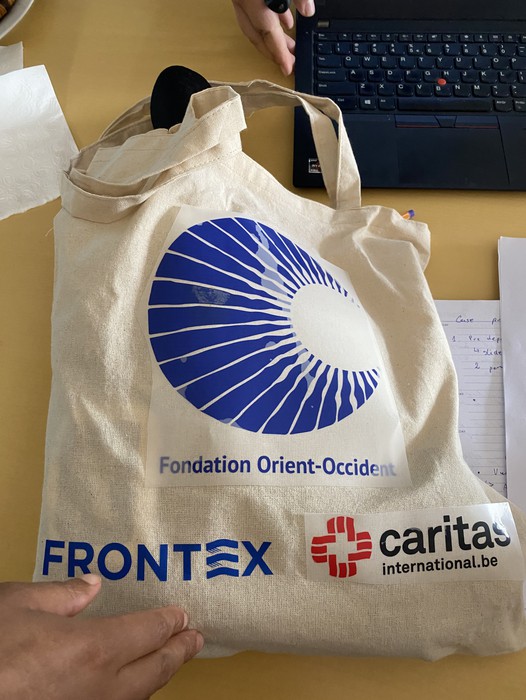
Header image: The tote bag that "voluntary" deportees to Morocco receive as part of Frontex' programme in the country. Credits: Frontex
Earlier this year, an employee within Frontex’ European Reintegration Programme (EURP) contacted us to blow the whistle on the issues they witnessed within the programme. To confirm their identity, they shared with us material that only a source internal to the programme could obtain. They agreed to answer some of our questions on the EURP programme, and how it is failing the people it claims to serve. The employee asked us to protect their identity for potential risks of retaliation.
When you first reached out to us, you signed off your email as “a concerned professional within the return sector”. Could you start by explaining why you contacted us?
In the past few years, I have been working in programmes funded by the EU, Frontex, and national authorities that aim to support people on the move returning from different EU member states to their country of origin/return. I worked at Caritas, which is a partner organisation of Frontex in this programme.
This role has given me an inside view of the full cycle of return. The contrast between the "solidarity principles" I look up to and the realities of this system is big. There is a systemic gap between policy and practice, and serious ethical challenges concerning the rights and treatment of individuals before, during, and after their return.
Could you explain to us what you mean by a return? How is it different from a deportation?
In practice, there are not really any differences. Return is the broader term for removing people from a territory. It can be a forced deportation, such as those where people are forced onto a plane in handcuffs. Generally, returnees themselves experience it as a deportation and it was definitely not voluntary.
The programme I was part of was meant to be a social project: an individual who is returning from Europe can receive about €2,000 as part of their return to spend on their “reintegration”. It is presented as a way to create a social safety net to help people who have been removed, by helping them open a business for example. In reality, this is not possible: because of the strict controls exerted on returnees after their return, they cannot reintegrate back into society in a way that values their dignity.
For example, people cannot even access the money to buy food or drinks. This money needs to be used within 1 year after they are returned, otherwise they “lose” it. If it is used for rent, it has to be for a new rental - and not to support an existing living arrangement they might be returning to.
Ultimately, with all these restrictions, it becomes clear that the goal of the programme is to deport people at all costs: the money is just a means to facilitate the deportation, because it forces people to stay silent.
What do you mean by strict controls? Who is exerting these controls?
Frontex. They supervise the return from start to finish. Sometimes, they are involved even in what they call the “pre-return” phase: this is the part where “Frontex counselors” speak to people who are supposed to be deported when member states have difficulties to do that part, and try to convince them to leave.
But Frontex checks every cent that is spent or given to every person that is being deported. Frontex controls every aspect of the program, they have the decision making power from how the money is used.
On the ground, this translates into partner organisations, such as Caritas, controlling the lives of people who return.
Say, for example, a returnee wants to use their allowance to buy supplies for a business. Everything that they buy needs an invoice, because, in principle, returnees are not allowed to pay for the supplies themselves. However, many countries are cash-based, and they don’t deal with invoices, which means returnees can’t effectively use the money. A lot of time, there is no way to create the receipts that Frontex demands.
What about the partner organisations? What is their role?
They do the social side of things: they communicate between the local partners and Frontex. They also sometimes provide pre-return assistance: they send their own counsellors to speak to deportees. They are of course aware that these are people who are going to be deported.
The main issue for a lot of the partner organisations is the funding structure. These programmes rely heavily on funds from the EU and Frontex, which creates an inherent conflict of interest. This dynamic often silences criticism and leaves systemic failures unreported.
The partner organisations are left in the dark about many of the vulnerabilities of the people who are returning. I have observed that the “return counselors” do not do a clear and accurate analysis of a person’s vulnerability, or they simply do not provide us the information, even though they are required to.
What are the stories of deportees who have stuck with you?
Too many to count.
There was the case of a Palestinian man living in Germany who had residency in Jordan. He had gotten married to a German woman and they had a child together. After their divorce, he lost his papers and was deported back. Now, he cannot see his son anymore.
There was the case of a woman who was deported from Sweden to Jordan while 8 months pregnant. I met her when I went to Jordan, and I remember her telling me that she asked the Swedish government to wait until after the baby was born to deport her, but they refused. Due to the stress of the trip, she lost her baby only a few days before she could give birth in Jordan.
There was another woman, who was deported with her child from Poland to Moldova. While she did have a residency permit in Moldova, she had received it during her journey to Europe. She did not actually have a life there, nor family or friends. Because it would have taken too long for the Polish government to arrange her documents to her home country, they deported her to Moldova with her child. She was a very vulnerable woman.
The Border Violence Monitoring Network accepts submissions for its blog. To contribute, please send your submission to press@borderviolence.eu
Thank you for your interest. We look forward to your contribution!