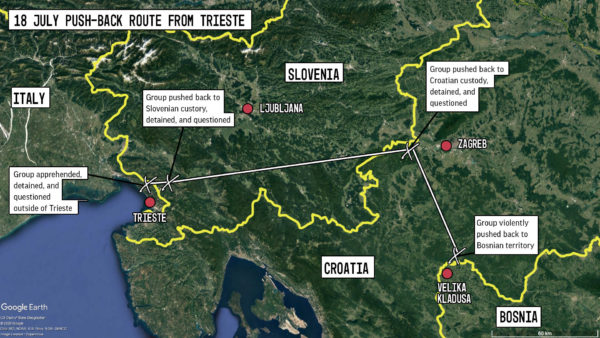
After two hours travelling, the cars reached the border to Slovenia and the Italian police officers handed the respondents over to the Slovenian police
| 18.07.2020 | Staro Selo Topusko, Croatia | No Name Kitchen | 45.224769, 15.959686 | Croatia | Bosnia | yes | no | yes | no | no | no | no | 19 - 21 | 15 | Afghanistan | detention, fingerprints taken, photos taken, personal information taken, papers signed, denial of food/water, forcing to undress, frisking | 54+ | beating (with batons/hands/other), exposure to air condition and extreme temperature during car ride, forcing to undress, theft of personal belongings, reckless driving | 15 Italian police officers (2 female officers) with blue uniforms and beige and black uniforms, 2 police vans, 1 police car; 1 unidentified Italian man with a gun but no official uniform; 25 Italian police officers wearing blue uniforms and beige and black uniforms, 5 police cars; unknown number of Slovenian police officers at the border between Italy and Slovenia, unknown number of Slovenian police cars; 1 male and 1 female Slovenian police officers with blue uniforms; 4 Slovenian male police officers, 2 police vans; 7 Croatian police officers (1 female), 2 police cars, 1 police van |
In this case, a group of 58 people from Afghanistan were stopped in the Italian city of Trieste by the Italian police, around 11:00 in the morning on the 17th of July 2020. Of this group, 24 managed to escape, whereas 34 were caught by the officers. The group of concern in this report consisted of 34 Afghan males, of which 17 minors and 17 adults, aged 19-21.
Approximately 15 Italian police officers, two of which were female officers, with two police vans and one police car, stopped the group which was walking on the street, heading to a bus station. According to the description given by the respondent, some of the officers were wearing blue uniforms and others were wearing beige and black uniforms. The officers ordered to the group to sit on the side of the street, in a “sunny area”. The respondent described the police behaviour as “respectful”, nonetheless, police forced the group of respondents to stay silent for more or less two hours, by ordering them “not to speak between each other”. The officers also checked the contents of the respondents’ backpacks.
After waiting for two hours, a vehicle came and the group was loaded on it. Two of the 15 police officers were with them. The bus drove for around 20 minutes and stopped at a place which the respondent describes as a sort of camp, with gates and fences, close to which or in which there was a police station.
“Behind of camp it was one police station”, says the respondent.
Once inside the police station, the whole group of respondents was checked by two doctors, who “checked our all body and corona”. After this, the group was divided and went through administrative procedures at the police station. The respondent had the fingerprints of all fingers of both hands taken, as well as pictures of his face. He was also asked for personal information such as name, surname, date of birth, country of origin, mother’s and father’s name.
The respondent described interacting with with a translator who spoke Pashto and another unidentified Italian man, with whom the respondent had a long oral interview, which lasted around 1 and a half hours, according to his memory. The unidentified Italian man had a handgun but no official uniform, so the respondent could not determine if he was a police officer or not.
“They ask all my problems what we were in Afghanistan and how I come from Afghanistan so I was like big interview”, says the respondent.
As the respondent refers, several times he asked for asylum to the translator but the translator did not communicate this to the other man, as well as many other questions or requests which the respondent made to him. “They do not give answer, just they laugh”, says the respondent. Afterwards, the respondent was given “five” documents written in Italian, whose contents he was unable to understand because of the language, and was forced to sign them quickly.
“When we signed the documents we don't had time for look to paper, we signed and when we signed one paper translator told us “this is asylums paper” and after we signed one another paper he told us “this paper is from illegal that you come to Italy” [and so on]”, says the respondent.
After the whole procedure, the whole group was reunified in the afternoon, at around 14:00 in a big tent placed at the back of the police station. There, the group got some food and had rest for around four hours; since it was early in the afternoon, the temperature inside the tent was extremely hot. Later in the evening, at around 18:00, a group of approximately 25 Italian police officers wearing blue uniforms and black and beige uniforms came with the translator to the tent and woke the group up. The respondents were asked if they wanted to remain in Italy and all of them answered affirmatively, but only the 17 minors and two adults who previously had had their fingerprints taken in Greece were allowed to stay. All the remaining group-members, 15 people in total, were then divided into five groups of three, loaded in five police cars and left the station.